
Quick Summary: To calculate the right BTU for your window AC, measure your room size in square feet and multiply by 20 for a basic estimate, then adjust for sun exposure and ceiling height. Aim for the sweet spot—not too big, not too small—to save energy and stay comfy!
Are you staring at confusing charts trying to buy a new window AC? It is easy to feel lost when you see all those numbers like BTUs. Picking the wrong size means high electric bills or an AC that just won’t cool your space down. Don’t worry; I’m Jack from ACReviewHub, and I promise to make this simple.
By the end of this guide, you will know exactly what BTU rating you need for any room. We will break down the technical talk into easy steps you can follow right now. Let’s get you set up for perfectly cool comfort!
What Exactly is BTU in Air Conditioning?
BTU stands for British Thermal Unit. That sounds fancy, but it is just a measurement. Think of it like this: BTU measures how much heat an AC unit can remove from a room in one hour.
A higher BTU number means the unit can cool a larger space faster. But here is the trick: a unit that is too powerful can actually cause problems. We want the Goldilocks size—just right!
Step 1: Measuring Your Space (The Easy Way)
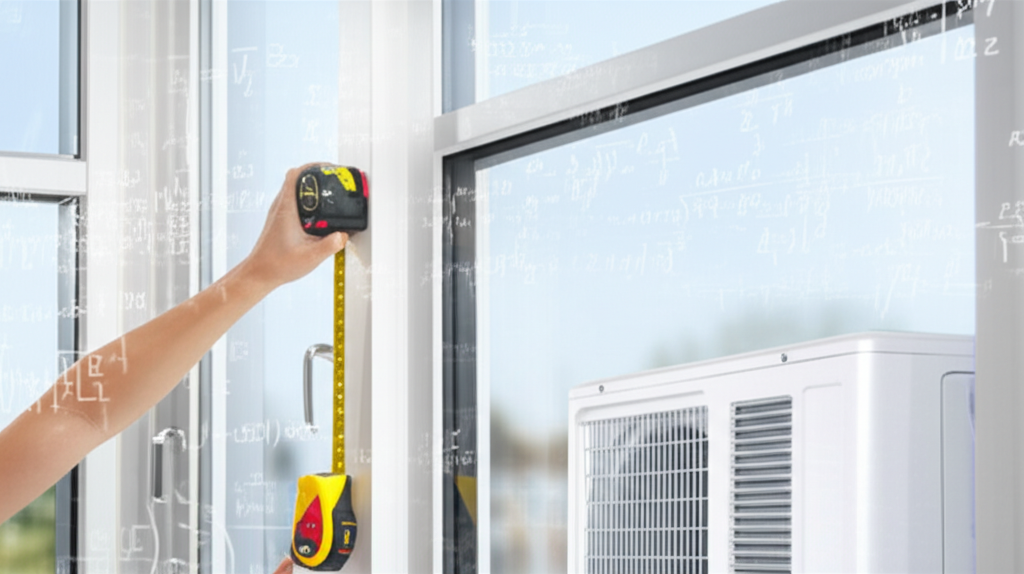
Before anything else, you need to know the size of the area you want to cool. This is where square footage comes in.
Follow these simple steps to find your room size:
- Measure the length of the room in feet.
- Measure the width of the room in feet.
- Multiply the length by the width (Length x Width = Square Footage).
For example, if your room is 10 feet long and 12 feet wide, you have 120 square feet (10 x 12 = 120).
Step 2: The Basic BTU Calculation Formula
Now that you have your square footage, we can get a starting BTU number. For most standard homes, the general rule of thumb is easy to remember.
We use a baseline of 20 BTUs per square foot. This is the foundation for your calculation.
Basic Calculation: Square Footage x 20 = Starting BTU Estimate
If your room is 200 square feet, your starting point is 4,000 BTUs (200 x 20 = 4,000).
Step 3: Adjusting Your BTU for Real-World Conditions
Most rooms are not perfect boxes with no windows. You need to adjust that starting number based on how hot the room actually gets. This is where you become an AC expert!
Here are the main factors that require you to bump your BTU number up or down:
- Sunny Rooms: If the room gets strong, direct afternoon sun, you need more power. Add 10% to your starting BTU number.
- Shady Rooms: If the room stays cool and shaded all day, you can subtract 10% from your starting BTU number.
- Kitchens: Ovens and stovetops create a lot of extra heat. Always add 4,000 BTUs if you are cooling a kitchen area.
- Ceiling Height: If your ceilings are higher than the standard 8 feet, you have more air volume to cool. Add about 10% for very high ceilings.
Let’s look at a quick comparison chart so you can see the standard sizes:
| Room Size (Sq. Ft.) | Recommended BTU Range | Why This Size? |
|---|---|---|
| 150 to 250 | 5,000 to 6,000 | Small bedrooms, offices |
| 250 to 350 | 7,000 to 8,000 | Average living rooms |
| 350 to 450 | 9,000 to 10,000 | Larger open areas |
| 550 to 700 | 12,000 to 14,000 | Big family rooms or studios |
The Biggest Mistake: Buying an AC That’s Too Big
I see this all the time, and it costs people money. It seems logical that a bigger AC cools faster, right? Not always!
An oversized AC blasts cold air very quickly. It cools the room down to the thermostat setting before it has run long enough to pull out the humidity. This leaves you feeling sticky and clammy, even if the temperature number is correct.
When an AC doesn’t run long enough, it also wastes energy and wears out parts faster. We want steady, dehumidifying cooling, not short, powerful bursts.
When You Have More Than One Room to Cool
If you are trying to cool an open-concept space or several connected rooms, you need to calculate the total square footage of the entire area. Add all the lengths and widths together for the combined space.
If you are cooling two separate, distinct rooms, you must calculate the BTU needed for each room individually and buy two separate units. Never try to cool two separate rooms with one unit.
For more detailed official sizing guidelines, the U.S. Department of Energy has great resources on sizing your home cooling systems. Check out the DOE guide here.
Quick Troubleshooting: My AC is Running But Not Cooling Enough
If you calculated your BTU correctly but still feel warm, don’t panic. Here are the top three simple things to check before calling a repair person:
| Symptom | Possible Cause (Easy Fix) |
|---|---|
| Air coming out is weak or warm | Filter is clogged. Clean or replace the air filter immediately. |
| Unit is running constantly | Room is oversized for the BTU, or the sun load is too high (need shades). |
| Water leaking inside | The unit isn’t draining properly, or the unit is not level in the window. |
Remember to always clean your filter once a month during heavy use. A clean filter lets the AC breathe properly, maximizing its cooling power!
FAQ: Answering Your Quick AC Questions
Here are some common questions I hear all the time:
Q: Do I need a higher BTU if I have high ceilings?
A: Yes! High ceilings mean more air volume. Add about 10% to your total BTU for every extra foot over 8 feet.
Q: What if my room size falls exactly between two BTU sizes?
A: If your room is right in the middle, it is usually safer to size up slightly, especially if it is a sunny room or used as a kitchen. A slightly larger unit will handle the heat spikes better.
Q: Can I use an AC rated for a 500 sq. ft. room in a 300 sq. ft. room?
A: You can, but you risk the short-cycling problem—it will cool too fast and won’t dehumidify, leaving you sticky. Stick to the recommended size if possible.
Q: Do I need to account for people in the room?
A: Yes, bodies generate heat! For every person regularly occupying the room beyond the first two, add about 600 BTUs to your total calculation.
Q: Is there an Energy Star rating for BTUs?
A: Yes. When comparing two units with the same BTU, always look for the higher Energy Efficiency Ratio (EER) or Seasonal Energy Efficiency Ratio (SEER). Higher numbers mean lower bills.
Q: How do I know if my window AC is cooling efficiently?
A: It should run for at least 15 minutes before shutting off on a typical hot day. If it cycles on and off every 5 minutes, it is likely too big or clogged up.
Final Thoughts on Sizing Your Cool Zone
Calculating the right BTU for your window AC doesn’t require an engineering degree. It just takes a quick measurement and a few common-sense adjustments for sun and heat sources.
By following these steps—measure, calculate the baseline, and adjust for real-world factors—you guarantee efficiency and comfort. Consistency with small maintenance tasks keeps that perfect BTU working hard for you year after year.
You’ve got this — and cool, comfortable air is just a few simple steps away.
