
Quick Summary: Mini-splits are surprisingly energy efficient! They usually use much less electricity than old window units because they cool only the space you need. Expect daily costs to be low, often just pennies per hour when running moderately.
Are you staring at your electric bill, wondering why your cooling costs are so high? You are not alone. Many folks get confused when looking at air conditioner specs. Terms like BTUs and SEER ratings sound like complicated jargon. But picking an AC that saves you money is actually quite simple.
I’m Jack from ACReviewHub.com, and I want to take the guesswork out of cooling your home. We are going to break down exactly how much electricity your mini-split uses. By the end of this guide, you will know how to keep your home cool without getting shocked by the bill.
Understanding How Mini-Splits Sip Electricity
The big secret to mini-split savings is that they are highly efficient. They are not like old central ACs that blast cold air everywhere, even to empty rooms. Mini-splits are ductless, meaning they send the cold air exactly where you want it.
This efficiency comes down to two main things: inverter technology and sizing. Inverter compressors ramp up and down smoothly, unlike old systems that just turn completely on or completely off. This smooth running saves a ton of energy.
The Magic of SEER Ratings Explained Simply
When shopping for any AC, you will see the SEER rating. This stands for Seasonal Energy Efficiency Ratio. Think of it like MPG for your car. A higher number means better gas mileage, or in this case, better electricity use.
For mini-splits, you often see SEER ratings of 18, 21, or even higher. A higher SEER unit will always cost less to run than a lower SEER unit, even if both are the same size.
| SEER Rating Range | Efficiency Level | Typical Savings Potential |
|---|---|---|
| 14–16 | Good (Minimum Standard) | Standard efficiency |
| 17–20 | Very Good | Noticeable savings over older units |
| 21+ | Excellent (High-End Mini-Splits) | Maximum long-term savings |
How Many Watts Do Mini-Splits Actually Use?
This is the question everyone asks! The actual electricity usage depends on three main things: the unit’s size (BTUs), the outside temperature, and how hard the compressor is working.
A small, 9,000 BTU unit running on a mild day will use very little power. A massive 36,000 BTU unit fighting a heatwave will use much more.
Here is a simple way to estimate the running wattage for a typical ductless mini-split unit:
| Mini-Split Size (BTU) | Approximate Running Watts (Medium Load) | Estimated Daily Energy Use (at 8 hours) |
|---|---|---|
| 9,000 BTU (Small Room) | 450 – 800 Watts | 3.6 – 6.4 kWh |
| 18,000 BTU (Large Room/Zone) | 900 – 1,500 Watts | 7.2 – 12 kWh |
| 24,000 BTU (Open Area) | 1,200 – 2,000 Watts | 9.6 – 16 kWh |
To figure out your cost, you need to know your local electricity rate (cents per kilowatt-hour, or kWh). You can usually find this on your electric bill. Divide your running watts by 1,000 to get kilowatts (kW). Then multiply kW by the hours it runs.
For example, if your 18,000 BTU unit runs at 1,200 Watts (1.2 kW) for 8 hours, that’s 9.6 kWh. If your rate is 15 cents per kWh, your cost is 9.6 x $0.15 = $1.44 for those 8 hours.
Sizing Matters: Why Too Big Is Too Costly
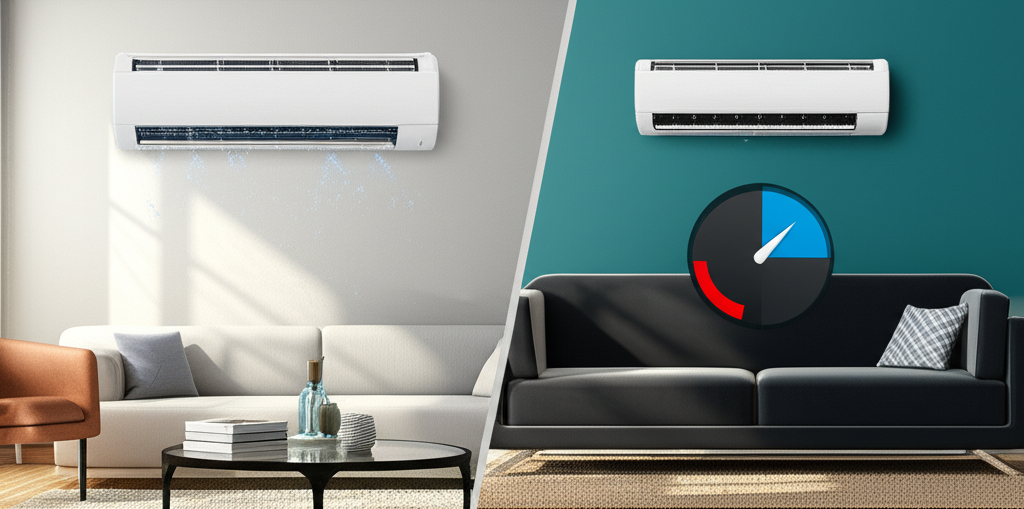
Beginners often think bigger is better for cooling power. That is a costly mistake with mini-splits. If you buy an AC that is way too big for the space, it cools the room down too fast.
When an oversized unit cycles on and off quickly, it never runs long enough to properly dehumidify the air. This leaves your room feeling cold but clammy and sticky. It also wastes electricity due to constant starting and stopping. Always size based on square footage and insulation!
Three Simple Steps to Check Your Current Usage
If you already have a mini-split and want to know its real usage, here is how to check without getting technical:
- Find the Nameplate: Look on the side or bottom of the indoor or outdoor unit. You will find a sticker listing the rated amperage or wattage (W).
- Use a Kill-A-Watt Meter (Recommended): Plug a simple electricity usage meter (available at hardware stores) into the outlet, and then plug your AC unit into the meter. This shows you the exact real-time wattage draw.
- Monitor the Thermostat: Check the usage reading when the unit is just maintaining temperature (steady running) versus when it first kicks on (startup surge). The steady running cost is what matters most for long-term bills.
Top Energy-Saving Habits for Your Mini-Split
You can drastically lower the electricity usage without buying a new unit by changing how you use it. Think of these as easy wins for your wallet.
- Set the temperature higher in the summer (75°F or 76°F feels comfortable).
- Use the “Sleep” or “Eco” mode at night if your unit has one.
- Keep the air filter clean—a dirty filter makes the unit work much harder.
- Use ceiling fans to help circulate the cool air evenly, letting you set the thermostat a degree or two higher.
- Close off unused zones or rooms entirely.
For more in-depth information on energy efficiency standards, check out the Department of Energy’s guidance on HVAC systems [Energy.gov HVAC Info].
Troubleshooting Low Efficiency: Quick Fixes
If your bill suddenly spiked, don’t panic! Often, the problem is simple maintenance neglect, not a major breakdown.
| Symptom | Most Likely Cause | Quick Fix Action |
|---|---|---|
| High Bill, Poor Cooling | Dirty air filter | Clean or replace the filter immediately. |
| Unit Running Constantly | Thermostat set too low or direct sunlight | Raise the temperature; check for blocked vents or sun exposure. |
| Ice on Outdoor Unit | Low refrigerant (needs a professional) | Turn the unit off and call a technician for a leak check. |
Remember, cleaning that filter once a month is the single best thing you can do to keep electricity use low. It’s easy, and it makes a huge difference.
Frequently Asked Questions from New Owners
Q: Does turning the mini-split completely off and on save energy?
A: No, not usually. Because the inverter technology ramps up slowly, turning it off and on constantly makes it use more energy during those startup surges. It’s better to keep it running at a steady, higher temperature.
Q: What is the most energy-intensive part of the mini-split?
A: It’s the compressor located in the outdoor unit. When the temperature difference between inside and outside is huge, the compressor works the hardest and draws the most electricity.
Q: Can I run my mini-split 24/7?
A: Yes! Mini-splits are designed for continuous, low-power running thanks to their inverters. It’s often cheaper to run them constantly at 75°F than to blast them down to 68°F for a few hours.
Q: Do I need a dedicated circuit for a mini-split?
A: Most smaller, single-zone units plug into a standard outlet. Larger units (over 18,000 BTU) usually require dedicated, hard-wired circuits, just like a standard central AC unit. Check your model’s manual!
Q: How much does it cost to run a mini-split per day?
A: For a moderately sized unit in average weather, you are usually looking at between $1.00 and $3.00 per day. It really depends on your local electricity price.
Q: Is it better to use the “Dry” mode or the “Cool” mode if I just want less humidity?
A: The “Dry” mode uses less energy because the compressor runs at a lower speed, focusing only on pulling moisture out of the air, not heavy cooling. Use “Dry” when the temperature is okay but the air feels sticky.
Final Thoughts on Keeping Cool and Saving Cash
See? Understanding mini-split electricity use isn’t rocket science. These systems are fantastic tools for saving money because they are precise about where they send the cool air. The shocking truth is that they usually cost far less to run than the old window units they replace.
Stay consistent with your filter cleaning, don’t oversize your unit, and trust that steady operation saves energy. You’ve got this!
Stay cool and comfortable, my friend!
